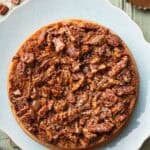
Pecan Upside Down Cake
If you love a dessert that’s cozy, elegant, and downright irresistible, this Pecan Upside Down Cake is about to be your new favorite. A light, airy, super simple vanilla génoise topped with glossy, toasted pecans, all drenched in a rich, buttery homemade butterscotch sauce (without corn syrup!). Nutty, sweet, and incredibly easy. Just flip, slice, and enjoy!
Servings: 10
Calories: 354kcal
Equipment
- 9-inch (23 cm) round pan (not a springform pan)
Ingredients
For the butterscotch pecan layer
- 40 g unsalted butter
- 70 g soft dark brown sugar (packed)
- ¼ teaspoon fleur de sel (or flaky sea salt)
- 80 ml heavy cream
- 150 g raw pecans (roughly chopped)
For the génoise cake
- 4 free-range eggs (at room temperature)
- ⅛ teaspoon fine sea salt
- 150 g granulated sugar
- 2 teaspoons vanilla powder or vanilla bean paste (alternatively you can use pure vanilla extract)
- 125 g cake or pastry flour
- 50 g melted unsalted butter
Instructions
Make the butterscotch pecan layer.
- Prepare the pan – Preheat the oven to 325°F (170°C) with the fan on. Generously butter a 9-inch (23 cm) round cake pan, then line the bottom with a round of parchment paper cut to fit. Brush the parchment paper with butter as well. Set aside.
- Make the butterscotch sauce – In a medium heavy-bottomed saucepan (avoid non-stick), melt the butter over medium heat. Add the brown sugar, salt, and heavy cream, stirring gently with a rubber spatula until smooth and well-blended. Bring the mixture to a gentle boil, occasionally scraping down the sides of the pan. Let it boil for 4 minutes, stirring often, until the sauce is velvety and slightly thickened.
- Add the pecans – Remove the saucepan from the heat and stir in the chopped pecans until evenly coated in the butterscotch sauce. Immediately pour the mixture into the prepared pan, spreading the pecans into an even layer. Set aside.
Make the génoise cake.
- Make the meringue – Separate the egg whites from the yolks. In a large mixing bowl, whisk the egg whites and salt on medium speed until foamy (about 45 seconds). Gradually add the sugar in three additions, whisking for 1 minute after each addition. Continue whisking until stiff peaks form, about 5 minutes total. Finish by increasing the mixer speed to high for 10 seconds to firm up the meringue.
- Add egg yolks and vanilla – Add the egg yolks and vanilla bean paste to the meringue. Mix on low speed until just combined, scraping the sides of the bowl to ensure everything is fully incorporated. Be careful not to overwork the batter and stop as soon as it’s mixed.
- Fold in the dry ingredients & butter – Sift the flour over the meringue mixture. Using a rubber spatula, gently fold by scooping from the bottom and lifting the mixture over the top. Repeat until fully combined, being careful not to deflate the meringue. Then, add the melted butter and fold it in gently, using the same delicate motions.
Bake the cake.
- Pour and bake – Pour the génoise batter over the butterscotch pecan layer. Bake for 35 minutes, or until the cake is risen, golden, and a toothpick inserted into the center comes out clean. Let the cake cool in the pan for 5 minutes (no longer). If the cake cools too much, it may stick when you try to remove it.
- Invert the cake – Carefully invert the cake onto a serving platter. Some of the caramel pecan topping may stick to the pan: that’s perfectly fine! Use a silicone spatula to gently scrape off any stuck bits and arrange them back on the cake. If the topping looks too flat in places, break up any larger pieces and scatter them to create visual interest. Enjoy warm or at room temperature!
Notes
- Weigh your ingredients – Baking is all about precision. A digital kitchen scale ensures consistent results by eliminating the inaccuracies of measuring cups. For foolproof baking, always weigh instead of measuring by volume.
- Avoid a springform pan – The caramel layer can leak out during baking, making a mess in your oven. Stick to a solid round pan for the best results.
- Line the pan with parchment paper – A round of parchment paper at the bottom of your cake pan reduces sticking when inverting. If some caramelized pecans stick to the pan, don’t panic—just scrape them off with a silicone spatula and arrange them back on top.
- Use room-temperature eggs – Cold eggs won’t whip properly. For a light and fluffy meringue, let eggs sit at room temperature for at least 30 minutes before baking.
- Fold the génoise batter gently – When folding in the dry ingredients and melted butter, use a scooping and lifting motion to keep the batter light and airy. Overmixing will result in a dense cake.
- Invert the cake while warm – Cool the cake in the pan for 5 minutes, then invert it while still hot. If it cools too much, it may stick—trust me, rescuing a stuck cake is no fun!
Nutrition
Calories: 354kcal | Carbohydrates: 34g | Protein: 5g | Fat: 23g | Saturated Fat: 8g | Polyunsaturated Fat: 4g | Monounsaturated Fat: 9g | Trans Fat: 0.3g | Cholesterol: 94mg | Sodium: 118mg | Potassium: 118mg | Fiber: 2g | Sugar: 23g | Vitamin A: 447IU | Vitamin C: 0.2mg | Calcium: 36mg | Iron: 1mg