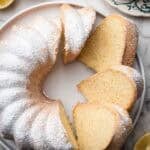
Savoy Cake "Gâteau de Savoie"
Savoy Cake (“Gâteau de Savoie”) – a classic French sponge cake that’s light as air and melts in your mouth. Made with simple pantry ingredients, it starts with a fluffy meringue, gently folded with egg yolks, citrus zest, and a delicate flour-cornstarch blend. Very easy to make, and perfect with tea!
Servings: 6
Calories: 339kcal
Ingredients
- 15 g unsalted butter (soft, to grease the pan)
- 6 free-range eggs (at room temperature)
- ⅛ teaspoon fine sea salt
- 200 g granulated sugar (+ more to coat the pan)
- 1 lemon (zest only)
- 1 lime (zest only)
- 75 g cornstarch (or potato starch)
- 75 g all-purpose flour
- powdered sugar (to dust on top of the cake)
Instructions
- Prepare the pan – Preheat the oven to 325°F (170°C) with the fan on. Using a baking brush, grease a bundt pan with butter. Sprinkle 1 or 2 tablespoons of sugar over the buttered surface, then turn the pan to ensure it’s fully coated. Place the pan in the fridge while you prepare the cake.
- Make the meringue – Separate the egg whites from the yolks. Place the whites in a large mixing bowl with the salt. Whisk until foamy, then gradually add the sugar in ⅓ portions, whisking for 1 minute after each addition. Continue whisking until stiff peaks form, about 5 minutes in total. Finish by turning the mixer to full speed for 10 seconds to firm up the whites.
- Incorporate the yolks and citrus – Add the egg yolks and lemon and lime zest to the meringue. Using the same mixer, mix on low speed until just combined, scraping the sides to ensure everything is fully incorporated. Once combined, stop mixing—be careful not to overwork the batter.
- Fold in the dry ingredients – Sift the cornstarch and flour over the meringue mixture. Using a rubber spatula, gently fold them in by scooping from the bottom and lifting the mixture over the top. Continue folding until fully combined, being careful not to deflate the meringue.
- Bake the cake – Transfer the batter into the bundt pan. Bake for 35 minutes, or until the cake is risen, golden, and a toothpick inserted comes out clean.
- Remove from the pan – Remove the cake from the pan and place it directly onto a cake stand or plate. Let the cake cool completely, then finish by dusting with powdered sugar and enjoy!
Notes
- Weigh your ingredients – While I’ve included volume measurements (cups and spoons), use metric gram measurements if possible. A digital kitchen scale is more accurate than cups, ensuring precise, consistent results. Since weight is exact and volume can vary, a scale eliminates inconsistencies and will invariably give better results.
- Choose the right pan – Traditionally, Savoy cake is baked in a Savoy or Kugelhopf pan, but modern versions work beautifully in a Bundt pan. Avoid soft silicone molds, as they won’t create the traditional crackly crust. Instead, opt for a non-stick, formed aluminum pan for the best results and easy cake removal.
- Butter and sugar the pan – Greasing the pan with butter and dusting it with sugar creates the cake’s signature crisp, crackly crust. Don’t skip this step!
- Use room-temperature eggs – Cold eggs won’t whip properly. Let them sit at room temperature for at least 30 minutes before baking to achieve the best fluffy meringue consistency.
- Gradually add the sugar – Incorporate the sugar in three stages to strengthen the meringue’s structure. This ensures it remains light and airy while staying stable enough to be combined with the other ingredients without collapsing.
- Handle the batter gently – When folding in the dry ingredients, mix gently to avoid deflating the batter. Use a folding motion (scoop from the bottom and lift it over the top) rather than stirring. This helps keep the meringue light and airy. Overmixing will result in a denser cake, which is exactly what we’re trying to avoid for a fluffy Savoy cake!
- Eliminate air pockets – As you pour the batter into the pan, gently press it down with a rubber spatula to remove air pockets. Then, tap the pan on the counter a few times to help the batter settle evenly. If you don’t mind a more rustic look, you can skip this step.
- Avoid using a cooling rack – Let the cake cool in the pan for a few minutes before carefully unmolding it onto a cake stand or serving dish. Avoid using a cooling rack, as the cake top will become sticky due to the meringue and will stick to the rack.
Nutrition
Calories: 339kcal | Carbohydrates: 65g | Protein: 7g | Fat: 6g | Saturated Fat: 3g | Polyunsaturated Fat: 1g | Monounsaturated Fat: 2g | Trans Fat: 0.1g | Cholesterol: 169mg | Sodium: 114mg | Potassium: 110mg | Fiber: 1g | Sugar: 34g | Vitamin A: 305IU | Vitamin C: 13mg | Calcium: 36mg | Iron: 2mg